
Flat flange gaskets
Ring and Full-face Gaskets
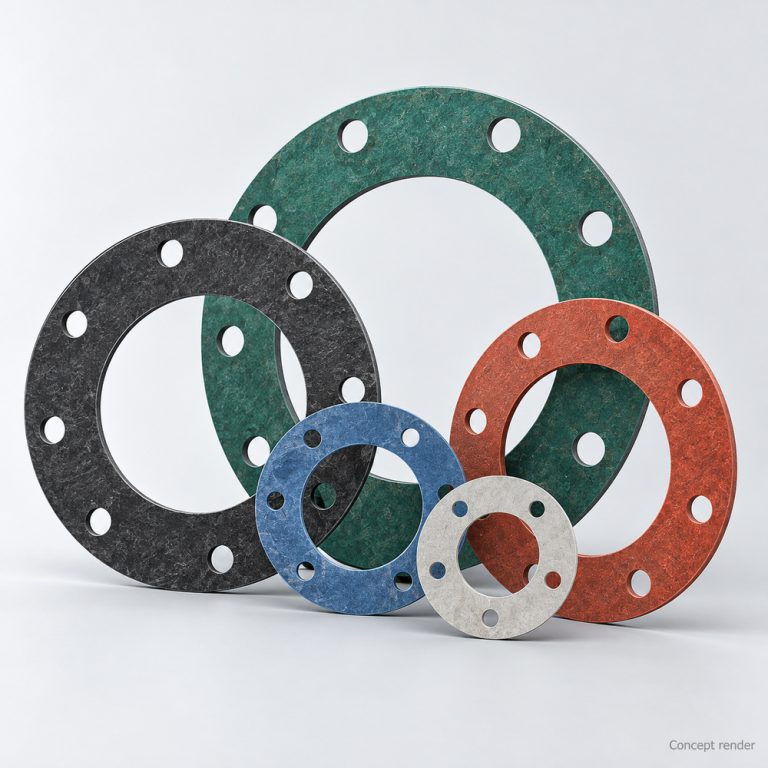
Flat flange gaskets come in two basic layouts: a ring gasket that sits inside the bolt circle, and a full-face gasket that covers the whole flange face including the bolt holes. Choosing between them depends on the flange face, the flange material and the duty. Globseals can help you match layout, material and thickness to your flanges and quote them cut to size.
- Ring and full-face layouts
- Fibre, rubber, PTFE, graphite
- Metallic ring joint gaskets
- SANS, ASME, EN, BS flanges

Overview
Ring gaskets, often called inside bolt circle (IBC) gaskets, are used on raised-face flanges. The gasket sits within the bolts, concentrating bolt load on a smaller area, which gives higher seating stress for a given torque. Full-face gaskets cover the entire face and are used on flat-face flanges, typically cast iron, ductile iron, plastic or GRP, where a ring gasket would let the flange bend when the bolts are tightened.
Both are cut from sheet material, so material choice and thickness are as important as diameter. Where the joint is a ring-type joint with a machined groove, a different, metallic gasket is needed.
Types and profiles
- Ring (IBC) gaskets: inside diameter to match the bore, outside diameter to sit within the bolts or against the raised-face edge.
- Full-face gaskets: outside diameter equal to the flange, with bolt holes and a central bore.
- Gaskets with bolt-hole pattern to drawing: for non-standard flanges, pump covers and machinery casings.
- Metallic ring-joint gaskets: oval or octagonal solid-metal rings for grooved flanges; also RX and BX styles, which are not interchangeable with each other. Fitting the wrong type damages the groove.
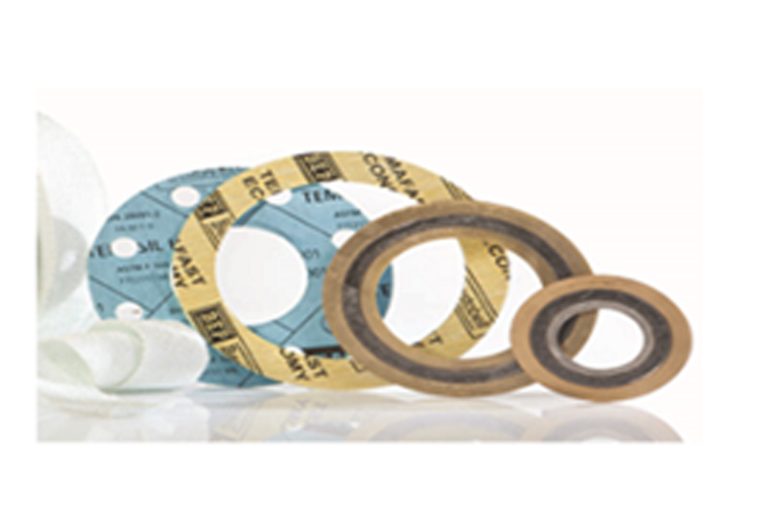
- Serrated and kammprofile gaskets: metal core with soft facing layers, sometimes used where a ring gasket does not give enough sealing performance.
Typical flange standards include SANS 1123, EN 1092-1, ASME B16.5 and older BS tables; confirm which applies before ordering.
Materials and thicknesses
| Material | Typical use | Notes |
|---|---|---|
| Compressed non-asbestos fibre | Water, steam, oils, general service | Check grade data for temperature and medium. |
| Rubber (NBR, EPDM, SBR, CR) | Water, air, oils, weak chemicals at low pressure | Best on flat-face flanges at low bolt load; see the elastomer comparison. |
| PTFE and filled PTFE | Aggressive chemicals | Can creep; re-torque may be needed. |
| Flexible graphite | High temperature | Often with a metal insert for strength. |
| Soft iron, carbon steel, stainless steel | Metallic ring-joint rings | The ring must be softer than the flange groove. |
Thickness is commonly 1.5 mm or 3 mm for sheet gaskets, but follow the flange requirements. Values here are typical only; always confirm against the manufacturer's data for your application.
How to choose the layout and material
- Identify the flange face: raised face needs a ring gasket; flat face usually needs full-face.
- Measure the flange outside diameter, the bore, the bolt-hole size, the number of holes and the pitch circle diameter.
- Decide on the medium, temperature and pressure, then pick a material family.
- Choose thickness: thinner gives better crush resistance and lower leakage, thicker takes up more uneven faces.
- For ring-joint flanges, identify the groove style and ring number from the flange.
Soft gaskets and high bolt load do not mix; over-tightening crushes sheet material. The gasket material selection guide sets out the logic in more detail.
Information to send with your enquiry
The more of the following you can supply, the faster the part can be identified and quoted.
- Flange standard and pressure rating (or PN)
- Bore, outside diameter, bolt-hole diameter, hole count and pitch circle diameter
- Flange face type: raised, flat, ring-type joint groove
- Medium, temperature and pressure
- Material and thickness, if specified
- Quantity
- Photo of the old gasket and flange, or a drawing
Genuine and compatible replacements
Customers can enquire about genuine or compatible replacement parts for equipment from manufacturers such as Burgmann, John Crane, Chesterton, Grundfos, KSB, Flygt, Lowara, Goulds, Sulzer, Flowserve, Klinger, Flexitallic, Trelleborg and others. A genuine part is supplied by or made to the original equipment manufacturer's specification and part number. A compatible part is made to fit the same dimensions and duty, usually by another manufacturer, and may differ in material or finish. For flat gaskets, compatible parts are normally cut to the same dimensions and bolt pattern, but the sheet grade may differ from the original, so ask for the sheet specification where it matters. State clearly in your enquiry which you want, and say whether a part number or sample is available.
How to buy
Globseals supports three ways to buy, and the right one depends on how well the part is defined.
- Buy online where a product listing shows a confirmed price. Products are being added to the shop progressively, so not every item in this category is listed yet.
- Request a quote for custom, bulk or unpriced items. Sheet gaskets cut to size, in quantity or in special materials, are quoted. Use the quote request page.
- Technical review when identification is unresolved. Examples include unknown flanges, ring-joint grooves, and any duty with hazardous media. Start with Find My Seal or upload a drawing.
You can also phone 011 079 6033 or WhatsApp 079 508 0989, or email info@globseals.com. See delivery and collection for how orders are handled; courier costs are quoted per order.
Options & specifications
| Profiles available | Ring (IBC), full-face, to-drawing shapes, metallic ring-joint |
|---|---|
| Common materials | Compressed fibre, rubber, PTFE, graphite, soft iron, stainless |
| Typical thickness | 1.5 mm and 3 mm common; other on enquiry |
| Flange standards | SANS 1123, EN 1092-1, ASME B16.5, BS tables |
| Typical use | Pipe flanges, pump covers, heat exchangers |
| Order mode | Quote for cut-to-size; technical review for ring-joint |
Options, materials and turnaround are confirmed on your written quote.
How ordering works
- 1
Identify
Gather part number, dimensions or a photo of the part.
- 2
Send
Submit it through the quote form, WhatsApp or email.
- 3
Review
Our team checks the details and asks about any gaps.
- 4
Order
Confirm the quote or buy online where a price is listed.
Frequently asked questions
When do I need a full-face gasket instead of a ring gasket?
Use full-face on flat-face flanges, especially cast iron or plastic, where leaving the outer part of the flange unsupported can crack it. Raised-face flanges normally take a ring gasket.
Can I cut a gasket myself from sheet?
For non-critical joints this is common practice, but edge quality and size accuracy affect sealing. A cut-to-size gasket quoted from your dimensions is usually neater.
Are ring-joint gaskets interchangeable?
No. Oval, octagonal, RX and BX rings fit different grooves, and the wrong ring can damage the flange. Identify the groove before ordering.
What thickness should I use?
It depends on the sheet material, flange condition and bolt load. Thinner gaskets generally cope better with higher pressure; thicker ones tolerate rougher faces. Ask for guidance if unsure.
Do you supply gaskets for steam or hot oil?
Yes, subject to enquiry. Provide medium, temperature and pressure so a suitable sheet or metallic type can be reviewed.
Request a quote for Ring and Full-face Gaskets
Related services
 Gasket Sheets and MaterialsGasket sheet is flat material sold in sheets, rolls or cut pieces, from which gaskets are cut for…View
 Cut and Custom GasketsMany gaskets are not available off the shelf: obsolete equipment, imported machines, non-standard flanges or special shapes. Cut…View
 Spiral Wound GasketsSpiral wound gaskets seal pipe flanges where pressure, temperature cycling or aggressive media rule out a plain sheet…View
 Custom Gasket ManufacturingWhen a flange, cover or housing has no off-the-shelf gasket, a custom-made part is the practical answer. Globseals…View
- Understanding Gasket Dimensions and Flange DetailsA gasket order is only as good as the dimensions behind it. This guide explains the terms used…View
 Request a QuoteUse this page for custom, bulk or unpriced items, or whenever you want a written quotation. A good…View
 Graphite Gaskets and PackingFlexible graphite is the standard answer for high-temperature joints in steam, thermal oil and hot process lines, and…View
 Compression PackingCompression packing, or gland packing, is a braided rope or ring placed in a stuffing box and squeezed…View
Send flange details for ring or full-face gaskets cut to size.
Send your brief, quantities and deadline. We reply with a clear written quote and confirm the turnaround before anything goes to production.
