
Flange sealing
Spiral Wound Gaskets
Spiral wound gaskets seal pipe flanges where pressure, temperature cycling or aggressive media rule out a plain sheet gasket. A V-shaped metal strip is wound together with a soft filler to give a gasket that is resilient, recovers as the joint moves, and tolerates modest flange imperfections. Globseals can help you identify the right winding, filler and ring arrangement for your flange standard and duty.
- Winding and filler options
- Inner and outer rings
- ASME and EN flange sizes
- Quote or technical review

Overview
A spiral wound gasket has three possible parts: the sealing element (alternating metal winding and filler), an optional outer centring ring that locates the gasket on the bolt circle and limits compression, and an optional inner ring that supports the winding on the bore side. Sealing happens as the bolts compress the winding until the gasket reaches its seating stress; the metal strip provides the spring-back and the filler fills the surface texture of the flange.
Because the gasket is a precisely engineered part, flange class or pressure rating, nominal size and flange face type matter more than for sheet material. Values here are typical only; always confirm against the manufacturer's data for your application.
Types and ring arrangements
- Winding only: the simplest form, used in tongue-and-groove or recessed flanges where the flange itself supports the gasket.
- With outer centring ring: the most common arrangement for raised-face flanges; the ring centres the gasket and acts as a compression stop.
- With inner ring: protects the winding from flow erosion and buckling inward, and is usually recommended with graphite or PTFE filler, in vacuum service and for larger sizes.
- With inner and outer rings: used for demanding duty such as thermal cycling and higher pressure classes.
- Heat exchanger and special shapes: oval, rectangular or pass-partition profiles made to drawing, which need a technical review.
Dimensions are normally taken from ASME B16.20 for ASME flanges or EN 12560-2 for EN flanges. Older British table flanges and SANS 1123 flanges are also met in Africa; confirm which applies before ordering.
Winding metals and fillers
| Component | Common options | Honest notes |
|---|---|---|
| Winding strip | 304, 316L, 321, 347, nickel alloys, titanium | 316L is the usual general choice; chloride, acid or high-temperature duty may call for a different alloy. |
| Filler | Flexible graphite, PTFE, ceramic or mica-based fillers | Graphite suits high temperature and many chemicals but oxidises in air at elevated temperature; PTFE resists most chemicals but can creep and has a lower temperature range. |
| Inner ring | Carbon steel, stainless steel | Should be compatible with the winding metal and the medium. |
| Outer ring | Carbon steel, often plated or painted, or stainless | Usually carbon steel; stainless where corrosion in the bolt area is a concern. |
Typical limits depend on the exact combination, so values here are typical only; always confirm against the manufacturer's data for your application. For wider background see the PTFE and graphite sealing guide.
How to choose a spiral wound gasket
Work through the joint in this order:
- Establish the flange standard, nominal size and pressure class or PN rating.
- Confirm the flange face: raised face, flat face, tongue and groove or male and female. Spiral wound gaskets are not intended for damaged or heavily pitted faces.
- Define the medium, operating temperature and pressure, including cycling and vacuum.
- Choose the winding metal for corrosion resistance, then the filler for temperature and chemical compatibility.
- Decide on inner and outer rings. When in doubt, ask for a technical review.
A spiral wound gasket must be compressed to its designed thickness, so bolt loading and torque sequence matter. These gaskets should not be reused once a joint has been opened. Further reading: understanding gasket dimensions and flange details.
Information to send with your enquiry
The more of the following you can supply, the faster the part can be identified and quoted.
- Flange standard and class or PN rating
- Nominal pipe size, or inside and outside diameters from a measured gasket
- Flange face type and surface condition
- Medium, temperature range and operating pressure
- Winding and filler materials, if specified
- Inner and outer ring requirement
- Quantity and whether the order is a one-off or repeat
- Photo of the old gasket and the flange, plus any drawing
Genuine and compatible replacements
Customers can enquire about genuine or compatible replacement parts for equipment from manufacturers such as Burgmann, John Crane, Chesterton, Grundfos, KSB, Flygt, Lowara, Goulds, Sulzer, Flowserve, Klinger, Flexitallic, Trelleborg and others. A genuine part is supplied by or made to the original equipment manufacturer's specification and part number. A compatible part is made to fit the same dimensions and duty, usually by another manufacturer, and may differ in material or finish. Because spiral wound gaskets are built to a flange standard, a compatible gasket usually matches ring thickness, winding material and filler, not just diameter. Materials may differ from the original unless you ask for an equivalent. State clearly in your enquiry which you want, and say whether a part number or sample is available.
How to buy
Globseals supports three ways to buy, and the right one depends on how well the part is defined.
- Buy online where a product listing shows a confirmed price. Products are being added to the shop progressively, so not every item in this category is listed yet.
- Request a quote for custom, bulk or unpriced items. Bulk, special-material and non-standard-size spiral wound gaskets are quoted. Use the quote request page.
- Technical review when identification is unresolved. Examples include unknown flange standards, hazardous media, high-pressure steam, and heat exchanger shapes. Start with Find My Seal or upload a drawing.
You can also phone 011 079 6033 or WhatsApp 079 508 0989, or email info@globseals.com. See delivery and collection for how orders are handled; courier costs are quoted per order.
Options & specifications
| Profiles available | Winding only; with outer ring; with inner ring; with inner and outer rings; special shapes to drawing |
|---|---|
| Common winding metals | 304, 316L, 321, nickel alloys, titanium |
| Common fillers | Flexible graphite, PTFE, mica or ceramic |
| Typical standards | ASME B16.20, EN 12560-2, others on enquiry |
| Typical duty | Flanged pipework with pressure and temperature variation |
| Order mode | Quote or technical review for most items |
Options, materials and turnaround are confirmed on your written quote.
How ordering works
- 1
Identify
Gather part number, dimensions or a photo of the part.
- 2
Send
Submit it through the quote form, WhatsApp or email.
- 3
Review
Our team checks the details and asks about any gaps.
- 4
Order
Confirm the quote or buy online where a price is listed.
Frequently asked questions
When does a spiral wound gasket need an inner ring?
An inner ring is commonly recommended with graphite or PTFE filler, in vacuum duty, at higher pressure classes and for larger sizes. The gasket manufacturer or relevant standard sets the requirement for your joint, so confirm it in a technical review.
Can I reuse a spiral wound gasket?
No. The winding takes a permanent set when compressed, so a gasket that has been in service should be replaced whenever the joint is opened.
What does the outer ring do?
It centres the gasket in the bolt circle and acts as a compression stop so the winding is not over-compressed.
Is graphite or PTFE filler better?
Neither is better in general. Graphite handles higher temperatures but can oxidise in air at the upper end; PTFE offers broad chemical resistance at lower temperatures. The medium and temperature decide it.
Can you supply spiral wound gaskets for oxygen or hydrogen service?
These applications require technical review and the correct certification documents before any supply can be confirmed.
Request a quote for Spiral Wound Gaskets
Related services
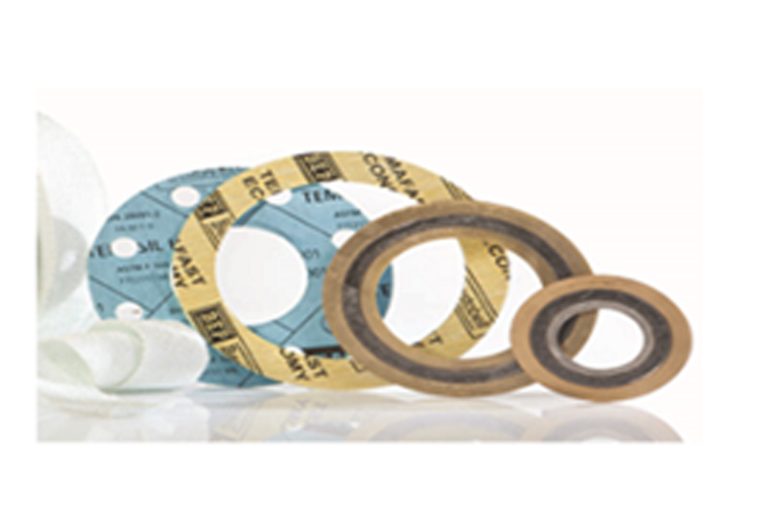 Ring and Full-face GasketsFlat flange gaskets come in two basic layouts: a ring gasket that sits inside the bolt circle, and…View
 Graphite Gaskets and PackingFlexible graphite is the standard answer for high-temperature joints in steam, thermal oil and hot process lines, and…View
 Gasket Sheets and MaterialsGasket sheet is flat material sold in sheets, rolls or cut pieces, from which gaskets are cut for…View
 Cut and Custom GasketsMany gaskets are not available off the shelf: obsolete equipment, imported machines, non-standard flanges or special shapes. Cut…View
 Gasket Material Selection GuideNo single gasket material suits every flange. Choosing well means matching the material to the medium, temperature, pressure,…View
- Understanding Gasket Dimensions and Flange DetailsA gasket order is only as good as the dimensions behind it. This guide explains the terms used…View
 Request a QuoteUse this page for custom, bulk or unpriced items, or whenever you want a written quotation. A good…View
 Compression PackingCompression packing, or gland packing, is a braided rope or ring placed in a stuffing box and squeezed…View
Send your flange standard, size and duty for a spiral wound gasket quote.
Send your brief, quantities and deadline. We reply with a clear written quote and confirm the turnaround before anything goes to production.
