
Seal support systems
Seal Support and Supply Systems
A mechanical seal does not work alone. It depends on the environment around it: cool, clean liquid at the faces, correct pressure, venting of vapour and sometimes an external barrier fluid. Seal support systems provide that environment through flush pipework, reservoirs, coolers, strainers and separators. Globseals can help you identify the arrangement your seal needs and supply the support components that go with it.
- Flush, quench and barrier plans
- Reservoirs, coolers and separators
- For single and double seals
- Pump and duty based selection
Overview
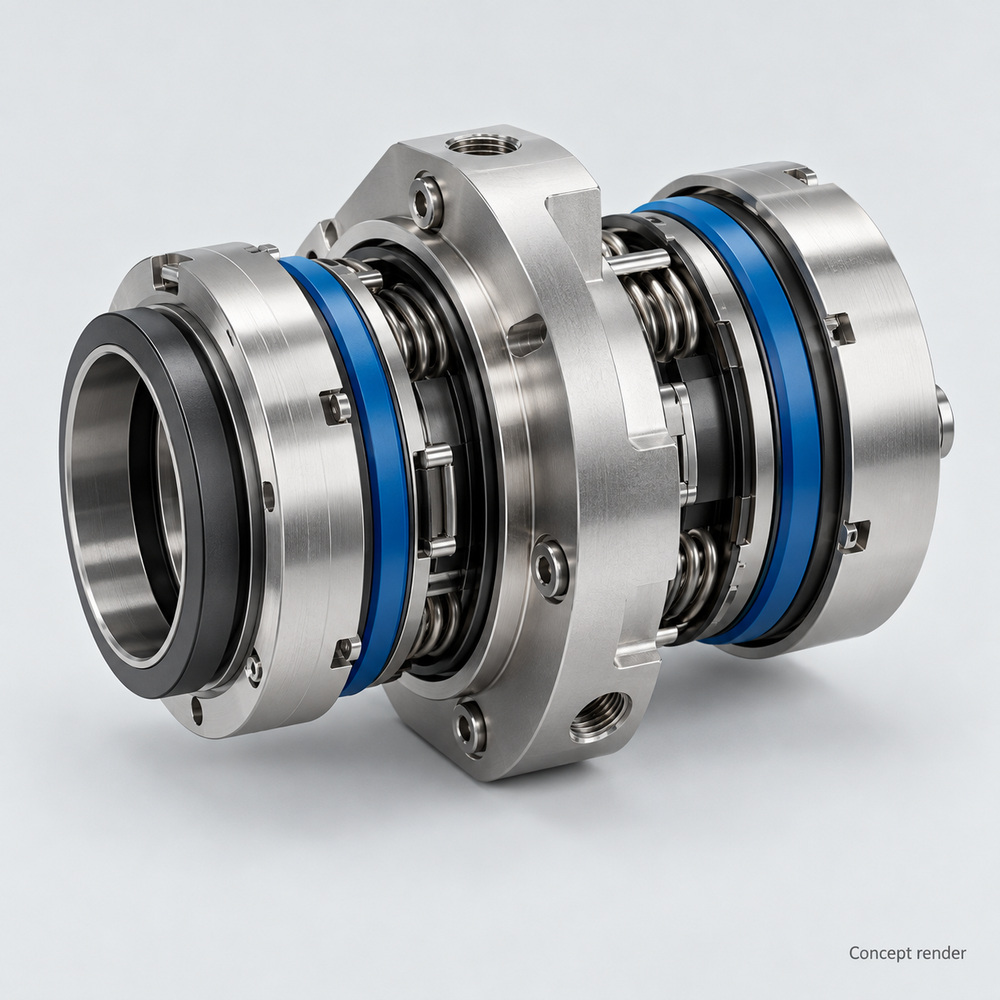
Most seal failures trace back to the seal environment, not to the seal itself. Heat at the faces, solids trapped in the chamber or loss of barrier pressure shorten life quickly. Support systems exist to manage those conditions.
The industry shorthand for this is the flush plan, a numbered piping arrangement published in API 682 and widely used beyond API pumps. It tells you how liquid reaches the seal, where it goes, and whether it is cooled, filtered or pressurised. A plan is only a starting point, since the correct one depends on the pump, the fluid and the seal design. Support systems are normally paired with Mechanical Seals or Cartridge Seals, particularly double arrangements.
Common support arrangements
Product flush (plans such as 11 and 13)
Plan 11 routes liquid from the pump discharge to the seal chamber through an orifice. Plan 13 recirculates from the seal chamber back to suction, mainly for vertical pumps and to vent the chamber. These use the pumped liquid, so it must be clean and compatible.
Flush with cooling or separation (plans such as 21, 23 and 32)
Plan 21 adds a cooler to a discharge flush. Plan 23 uses a pumping ring in the seal chamber and a cooler in a closed loop, common on hot services. Plan 32 injects clean external liquid into the chamber when the product is dirty or abrasive.
Cyclone separators (such as plan 31)
A cyclone separates solids from the flush stream before it reaches the chamber. Effective only where solids are denser than the liquid and flow is adequate.
Quench arrangements (such as plan 62)
An external fluid (steam, nitrogen or water) is passed on the atmospheric side of the seal to wash away crystallising product, cool the seal or dilute leakage.
Unpressurised buffer systems (plan 52)
A buffer liquid in a reservoir fills the space between tandem seals at a pressure below seal chamber pressure. Leakage from the primary seal collects in the reservoir and can be monitored.
Pressurised barrier systems (plans 53 and 54)
A barrier liquid held above seal chamber pressure keeps process fluid away from atmosphere. Plan 53 uses a reservoir, often pressurised by gas or a piston accumulator. Plan 54 uses an external pump or central system.
Materials and components in support systems
Typical component and material choices are listed below. Confirm against the manufacturer's data and your plant specification.
- Reservoirs and pots: usually carbon steel or stainless steel, with level indicators or switches, fill and vent connections and sometimes pressure gauges and transmitters.
- Heat exchangers and coolers: tube or coil designs in stainless steel or copper alloys, depending on the cooling water and fluid. Water quality and fouling should be considered.
- Tubing and fittings: stainless steel instrument tubing with compression fittings is typical for the small-bore pipework around seals.
- Orifices and strainers: sized for flow control and protection from particles, and they block easily if the liquid is dirty.
- Barrier liquids: chosen to be compatible with both the seal and the process. Water-glycol mixtures, light mineral oils or specialist barrier fluids are typical, and the right choice depends on temperature and process risk.
Choosing a support arrangement
Choosing a support plan usually means answering these questions in order.
- Is the liquid clean and compatible at the faces? If so, a simple product flush may be enough.
- Is the seal chamber hot? Hot liquids may need cooling in a closed loop.
- Does the liquid contain solids, crystallise or polymerise? If so, consider an external flush, separator or quench.
- Must leakage to atmosphere be controlled? This leads to double seals with a buffer or barrier system.
- What does the site standard require? Many plants specify plans and instrumentation.
Hazardous, toxic, hydrogen, oxygen and similar duties require technical review and the correct certification documents for any pressure equipment involved.
Information to send us
- Pump and seal make, model and arrangement, single or double
- Fluid, solids content, temperature and pressure at the seal chamber
- Flush or barrier plan number, if known
- Existing system drawing or photographs of pipework and reservoir
- Available utilities: cooling water, instrument air, nitrogen
- Connection sizes and orientation
- Quantity and whether instrumentation is required
Genuine and compatible replacements
Support components are often generic items, such as tubing, fittings and pressure gauges, but reservoirs and coolers designed for a given seal brand may be specific. A genuine system is supplied by the seal manufacturer and is designed around their seal. A compatible or locally assembled system can serve the same duty, provided pressure, volume, instrumentation and connection details are checked against the seal data.
You can enquire about genuine or compatible support equipment alongside seals from manufacturers such as Burgmann, John Crane, Chesterton and Flowserve. Scope and supply route are confirmed when you enquire.
How to buy
Support systems are usually specified rather than bought off the shelf, so most orders start with a quote request.
- Buy online: where a product is listed in the online shop with a confirmed price, you can order directly. Products are being added to the shop progressively, so not every item will be listed yet.
- Request a quote: for custom, bulk, unpriced or repeat-order requirements, send us a quote request with your details.
- Technical review: if you cannot identify the part, or the application is demanding, use Find My Seal or upload a drawing and our team will review it with you.
You can also call head office in Johannesburg on 011 079 6033, or WhatsApp 079 508 0989, or email info@globseals.com.
Options & specifications
| Common arrangements | Product flush, cooled flush, external flush, quench, buffer and barrier systems |
|---|---|
| Typical components | Reservoir, cooler, orifice, strainer, cyclone separator, tubing and valves |
| Instrumentation options | Level, pressure and temperature indication or switches |
| Applies to | Single, tandem and back-to-back mechanical seals |
| Reference scheme | Numbered flush plans, as set out in API 682 and widely used elsewhere |
| Key sizing data | Seal chamber pressure, temperature, heat load, fluid and utilities available |
Options, materials and turnaround are confirmed on your written quote.
How ordering works
- 1
Identify the seal arrangement
Single, tandem or back-to-back, and the seal make and model.
- 2
Define the duty
Liquid, solids, temperature and pressure at the chamber.
- 3
Select a plan
Agree the flush plan with your engineer or our team.
- 4
Quote and supply
Request a quote for the system and its instruments.
Frequently asked questions
What is an API flush plan?
It is a numbered, standard piping arrangement that describes how liquid is supplied to, circulated around or drained from a mechanical seal. Plans such as 11, 23, 52, 53 and 54 are among the most common.
Do all mechanical seals need a support system?
No. Many single seals on clean, cool service need only a simple flush or none. Support systems matter most for hot, dirty, hazardous or double-seal duties.
What is the difference between a buffer and a barrier fluid?
A buffer fluid sits at a pressure lower than the seal chamber and receives leakage. A barrier fluid is held above seal chamber pressure so that any leakage goes into the process, not out to atmosphere.
Can you supply a reservoir for an existing double seal?
Send us the seal details, plan number and site requirements and we can quote. Capability is confirmed when you enquire.
Does the barrier fluid need to be replaced?
Barrier liquids can degrade, become contaminated or be lost to leakage. Follow the seal manufacturer's guidance for checking and replacing it.
Request a quote for Seal Support and Supply Systems
Related services
 Mechanical SealsA mechanical seal controls leakage where a rotating shaft passes through a stationary housing, most often on centrifugal…View
 Cartridge SealsA cartridge seal is a complete mechanical seal assembled by the manufacturer on a sleeve and gland plate,…View
 Pumps and Pump SparesGlobseals supplies pump spares and, on enquiry, pumps for water, process and general industrial duty. Pump spares are…View
- Planned Maintenance and Reliability SupportReliability starts with knowing which components fail, why, and what to hold ready. Globseals can discuss planned maintenance…View
 Seal Selection and Application EngineeringChoosing a seal is a decision about the medium, the temperature, the pressure, the movement and the equipment,…View
 Component Mechanical SealsComponent mechanical seals are supplied as separate parts, not as a factory-assembled cartridge. The fitter sets the working…View
 Carbon Floating Ring SealsCarbon floating ring seals are non-contacting or lightly contacting restriction seals used on turbines, compressors, blowers and some…View
 Hydraulic SealsHydraulic seals contain pressurised oil in cylinders, rams, presses and valves while keeping dirt out and controlling friction.…View
Tell us the seal and duty and we will help you scope the right support arrangement.
Send your brief, quantities and deadline. We reply with a clear written quote and confirm the turnaround before anything goes to production.
