
V-rings and U-rings
V-rings and U-rings
V-rings and U-rings are named for their cross-sections, but they do quite different jobs. A V-ring is an axial lip seal that stretches over a rotating shaft and seals against a face, mostly to exclude dirt, water and grease. A U-ring (or U-cup) is a pressure-energised lip seal used mainly in reciprocating applications such as hydraulic rods and pistons. Globseals can help you identify which one you need, and the size, from your equipment.
- V-rings for shafts and dust exclusion
- U-rings for reciprocating seals
- Sizes by shaft or groove
- Rubber and polyurethane options

Overview
V-rings have a body that grips the shaft and rotates with it, and a flexible hinge-like lip that presses axially against a stationary face, such as a housing or a bearing end plate. Because they rotate with the shaft, they are thrown clear of debris by centrifugal action as speed increases. V-rings are cheap, easy to fit and tolerant of moderate shaft misalignment and runout. They are used as secondary seals ahead of oil seals and bearings, on motors, conveyor rollers, gearboxes, wheel hubs and agricultural machinery. They are not designed to seal pressure and are mostly used for grease retention and dirt exclusion.
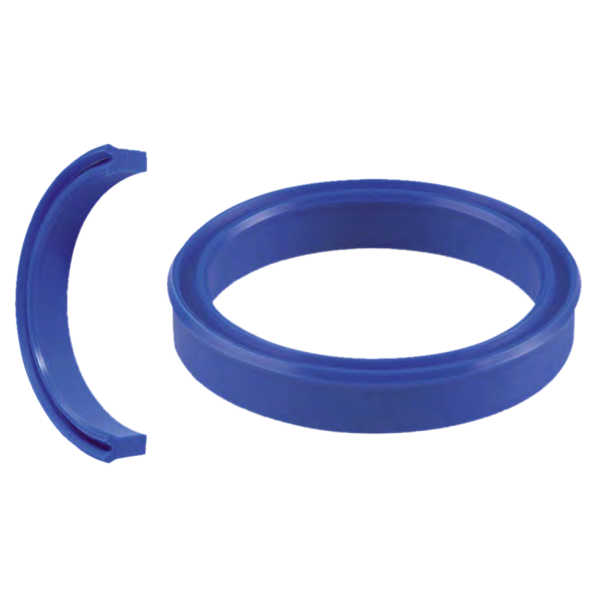
U-rings have a U-shaped cross-section with two lips, the sealing lip and a static lip, with the open side facing the pressure. System pressure forces the lips against the surfaces, which gives a self-energising effect. They are used in cylinders, rams and valves for rod or piston sealing. See Rod Seals and Piston Seals for the detailed treatment, and Rotary Shaft and Oil Seals for radial lip seals on shafts.
Types and styles
Standard V-rings (type A style)
Rubber V-ring with a body, hinge and lip, fitted on a shaft in a free position and held by its own tension.
Axially clamped V-rings
Fitted with a clamping band or against a retaining washer, used at higher speeds, since a plain V-ring can lift off the face at high surface speed.
V-rings for large shafts
Large diameter V-rings can be supplied as cut-and-joined rings, or split designs.
Rod U-rings (single lip)
U-cup shaped to seal a rod, with the sealing lip on the inside diameter, often with a dust lip.
Piston U-rings
U-cup with the sealing lip on the outside diameter, sealing against the cylinder bore.
Pneumatic U-cups
Lighter U-profiles for compressed air. See Pneumatic Seals.
U-rings with metal or fabric inserts
Reinforced profiles for higher pressure and heavier duty.
Materials
These notes are typical and general. Always confirm against the manufacturer's data for your application.
- NBR: the usual material for V-rings and U-rings, suited to mineral oils and greases. Weather resistance is limited.
- FKM: higher temperatures and chemical exposure. Check against the fluid in use.
- EPDM: water, steam in suitable grades and non-mineral fluids; not for mineral oil.
- Polyurethane (U-rings): high wear and extrusion resistance for hydraulic duty, with fluid and temperature limits that depend on the grade.
- Silicone: for V-rings in wide-temperature, low-stress service.
- Fabric-reinforced rubber: reinforced U-profiles for tougher service.
How to choose between and within the two types
- Decide the function. Excluding dirt from a rotating shaft points to a V-ring. Sealing pressure in a cylinder points to a U-ring.
- For V-rings: measure the shaft diameter and the distance between the face and the shaft shoulder. The ring must be stretched slightly and compressed axially to a set working height. Check surface speed, since plain V-rings can lift off at high speed without clamping.
- For U-rings: measure the rod or bore and the groove, as described in the hydraulic seal measuring guide. Note which lip faces the pressure.
- Check the sealing face finish. A smooth, flat face lets the V-ring lip seal with little wear.
- Choose the material from the fluid and temperature.
- Check pressure. V-rings are not pressure seals, and U-rings need a backup ring at higher pressure or larger gaps.
Information to send us
- Whether it is for a rotating shaft (V-ring) or a rod or piston (U-ring)
- Shaft diameter and fitted width for V-rings
- Rod or bore diameter and groove dimensions for U-rings
- Existing ring markings and photos
- Operating speed, pressure and temperature
- Fluid, grease or contamination to be excluded
- Quantity required
Genuine and compatible replacements
V-rings and U-rings are made by seal manufacturers to long-standing profile conventions, so equivalent items from different makers are often interchangeable at standard sizes. Genuine items come under the equipment maker's part number. For V-rings, check the shaft range and axial working height, and for U-rings, the groove fit and material grade, since small profile differences change sealing behaviour.
You can enquire about genuine or compatible parts for equipment from manufacturers such as Freudenberg/Simrit, Trelleborg, Hallite and Corteco.
How to buy
V-rings by shaft size are well suited to online ordering where listed.
- Buy online: where a product is listed in the online shop with a confirmed price, you can order directly. Products are being added to the shop progressively, so not every item will be listed yet.
- Request a quote: for custom, bulk, unpriced or repeat-order requirements, send us a quote request with your details.
- Technical review: if you cannot identify the part, or the application is demanding, use Find My Seal or upload a drawing and our team will review it with you.
You can also call head office in Johannesburg on 011 079 6033, or WhatsApp 079 508 0989, or email info@globseals.com.
Options & specifications
| V-ring function | Axial lip seal on a shaft, for dirt, water and grease exclusion |
|---|---|
| U-ring function | Pressure-energised lip seal for rods and pistons |
| Common materials | NBR, FKM, EPDM, silicone, polyurethane (U-rings) |
| Typical equipment | Motors, gearboxes, conveyors, hubs (V-rings); cylinders and rams (U-rings) |
| Size reference | Shaft diameter and width (V-ring); rod or bore and groove (U-ring) |
| Limitations | V-rings do not seal pressure; U-rings may need backup rings |
Options, materials and turnaround are confirmed on your written quote.
How ordering works
- 1
Pick the function
Dirt exclusion on a shaft or pressure sealing in a cylinder.
- 2
Measure
Shaft and width, or rod, bore and groove.
- 3
Describe the duty
Speed, pressure, fluid and temperature.
- 4
Order or review
Buy listed sizes or request a quote.
Frequently asked questions
Does a V-ring replace an oil seal?
No. A V-ring excludes dirt and retains grease but does not seal oil under pressure. It is often used in front of an oil seal as extra protection.
Can a V-ring be used at high speed?
At higher surface speeds a plain V-ring can lift from the face, so a clamping band or retainer is used. Check the speed limit for the specific ring.
Is a U-ring the same as a U-cup?
The terms are used interchangeably for the same U-shaped lip seal, although a particular manufacturer may define sub-types.
Which way does a U-ring face?
The open side of the U faces the pressure. Fitting it backwards will cause leakage.
Can V-rings be fitted without dismantling the shaft?
Cut-and-joined or split V-rings exist for large or hard-to-access shafts. The joint affects performance, so ask for technical review.
Request a quote for V-rings and U-rings
Related services
 Rotary Shaft and Oil SealsRotary shaft seals, commonly called oil seals, keep lubricant in and contaminants out where a rotating shaft passes…View
 Rod SealsThe rod seal is the main barrier between pressurised oil inside a hydraulic cylinder and the outside world.…View
 Piston SealsA piston seal seals the gap between the piston and the cylinder bore so that pressure on one…View
 Hydraulic SealsHydraulic seals contain pressurised oil in cylinders, rams, presses and valves while keeping dirt out and controlling friction.…View
 Pneumatic SealsPneumatic seals work in compressed-air systems, where the medium is a gas, pressures are lower than in hydraulics…View
 Bonded SealsA bonded seal is a metal washer with an elastomer sealing ring vulcanised to its inside edge. It…View
 Wiper and Scraper SealsA wiper, also called a scraper or dust seal, sits at the outer end of a cylinder gland…View
 Wear Rings and Guide RingsWear rings, also called guide rings, bearing rings or wear bands, are non-sealing rings that keep a piston…View
Tell us the shaft or groove size and application and we will help you choose a V-ring or U-ring.
Send your brief, quantities and deadline. We reply with a clear written quote and confirm the turnaround before anything goes to production.
