
Bonded seals
Bonded Seals and Dowty-type Sealing Washers
A bonded seal is a metal washer with an elastomer sealing ring vulcanised to its inside edge. It is used under bolt heads, drain plugs and fittings to seal threaded ports in hydraulic systems, engines, gearboxes and pipework. Globseals can help you size bonded seals by thread, and supply or quote them in common rubber compounds and metal types.
- Metal washer with bonded rubber ring
- Sized by thread and port
- Common for hydraulic and engine ports
- Zinc-plated and stainless options

Overview
The rubber insert sits on the inside diameter of the washer and projects slightly above and below the metal surface. As the fitting is tightened, the metal washer limits compression and the rubber fills the leak path. The washer prevents over-tightening and the rubber gives a seal that resists vibration better than a plain flat washer.
Bonded seals are widely known by the trade name Dowty seals, after the original design, and are also sold as "bonded washers" and "Usit rings", although some of these are brand names. They are normally for static sealing of port faces. Compared with an O-ring, they offer a built-in stop, and compared with a copper washer, they re-seal more easily. For free-standing rings, see Metric O-rings. For hose and port fittings, see Hoses and Fittings.
Bonded seal variants
Standard bonded seals
A flat metal washer with an inner rubber ring. Sized to a thread or port such as BSP, metric or UNF, though the washer bore is not identical to the thread diameter, so the size must be confirmed.
Self-centring bonded seals
Designed with a shaped metal ring that locates on the port edge, giving more consistent compression and positioning.
Stainless steel bonded seals
For corrosive environments, washdown areas or marine use. Rubber compound still needs to suit the fluid.
Zinc-plated or coated steel
The usual economic form. Plating protects against corrosion in storage and moderate environments.
Bonded seals with different compounds
Rubber inserts in NBR, FKM or EPDM, chosen by fluid and temperature.
Sealing washers for drain plugs
Often sold as sets matched to a vehicle or machine model, in compounds that suit oils and fuels.
Metal and rubber materials
These notes are typical and general. Always confirm against the manufacturer's data for your fluid and temperature.
- NBR insert: the standard choice for mineral oils, hydraulic oil, fuels and water at moderate temperatures.
- FKM insert: higher temperatures and many aggressive oils and fuels. Check suitability for hot water, steam and some brake fluids.
- EPDM insert: water-based fluids, brake fluids and some chemicals; do not use with mineral oils.
- Zinc-plated carbon steel washer: general industrial and hydraulic use.
- Stainless steel washer (304 or 316): corrosion-resistant. Select the grade for the environment.
- Hardness: inserts are typically around 70 to 80 Shore A. Confirm for your port.
How to select bonded seals
- Identify the port or thread. BSP, metric, UNF or NPT thread ports may use different washer sizes, and tapered pipe threads (NPT, BSPT) seal on the thread, not on a bonded washer.
- Measure the washer. Record inside diameter, outside diameter and thickness, plus the rubber ring profile.
- Check the sealing face. A washer needs a smooth, flat, undamaged face. Pitted or machined-rough faces will leak.
- Choose the rubber by fluid and temperature.
- Choose the metal by environment and cost.
- Replace on each service. The rubber takes a set after compression, so reuse often leads to weeping.
Information to send us
- Thread type and size, for example G1/4 BSP or M14
- Washer inside diameter, outside diameter and thickness
- Fluid and temperature
- Preferred rubber and metal types
- Equipment or fitting make and model
- Photos of the old washer and the port face
- Quantity, and whether a set is wanted
Genuine and compatible replacements
Bonded seals are made to long-standing dimensional conventions, so equivalent washers from different manufacturers often interchange. Genuine items are supplied under the equipment maker's part number, while compatible items follow the same dimensions. Differences appear in rubber bond quality, steel finish and the exact projection of the rubber ring, which can affect sealing on poor faces.
You can enquire about genuine or compatible parts for equipment from manufacturers such as Trelleborg, Freudenberg/Simrit, Corteco and Camozzi.
How to buy
Common bonded seal sizes are suited to online ordering where listed.
- Buy online: where a product is listed in the online shop with a confirmed price, you can order directly. Products are being added to the shop progressively, so not every item will be listed yet.
- Request a quote: for custom, bulk, unpriced or repeat-order requirements, send us a quote request with your details.
- Technical review: if you cannot identify the part, or the application is demanding, use Find My Seal or upload a drawing and our team will review it with you.
You can also call head office in Johannesburg on 011 079 6033, or WhatsApp 079 508 0989, or email info@globseals.com.
Options & specifications
| Construction | Metal washer with vulcanised rubber ring on the inside diameter |
|---|---|
| Common rubber inserts | NBR, FKM, EPDM |
| Common metals | Zinc-plated steel, stainless steel |
| Port types | BSP, metric and UNF straight-thread ports |
| Typical uses | Hydraulic ports, drain plugs, filter housings, gearboxes |
| Size reference | Thread size, plus inside diameter, outside diameter and thickness |
Options, materials and turnaround are confirmed on your written quote.
How ordering works
- 1
Identify the port
Confirm the thread type and size.
- 2
Measure the washer
Record the diameters and thickness.
- 3
Choose materials
Select rubber and metal for the duty.
- 4
Order or ask
Buy listed sizes or request a quote.
Frequently asked questions
Are bonded seals the same as Dowty seals?
Dowty is the original trade name, and "Dowty seals" is now used generally for this type. Confirm dimensions, since sizes are not set by the name.
Can I reuse a bonded seal?
It is not recommended. The rubber takes a set when compressed, and reuse often causes weeping. Replace the washer each time the fitting is opened.
Will a bonded seal work on a tapered thread?
No. Tapered threads such as NPT or BSPT seal on the thread itself. Bonded seals are for straight-thread ports with a flat sealing face.
How much should I tighten it?
Follow the fitting or equipment torque value. Over-tightening can crush the rubber or distort the washer, and under-tightening allows weeping.
Which rubber is right for hydraulic oil?
NBR is the common choice for mineral hydraulic oil, and FKM for higher temperatures. Confirm the fluid type, since some synthetic fluids need specific compounds.
Request a quote for Bonded Seals
Related services
 Metric O-ringsMetric O-rings are described by inside diameter and cross-section in millimetres, for example 20 x 3. They are…View
 Hoses and FittingsHoses and fittings connect pumps, tanks and process equipment, and incorrect threads or hose ratings are the most…View
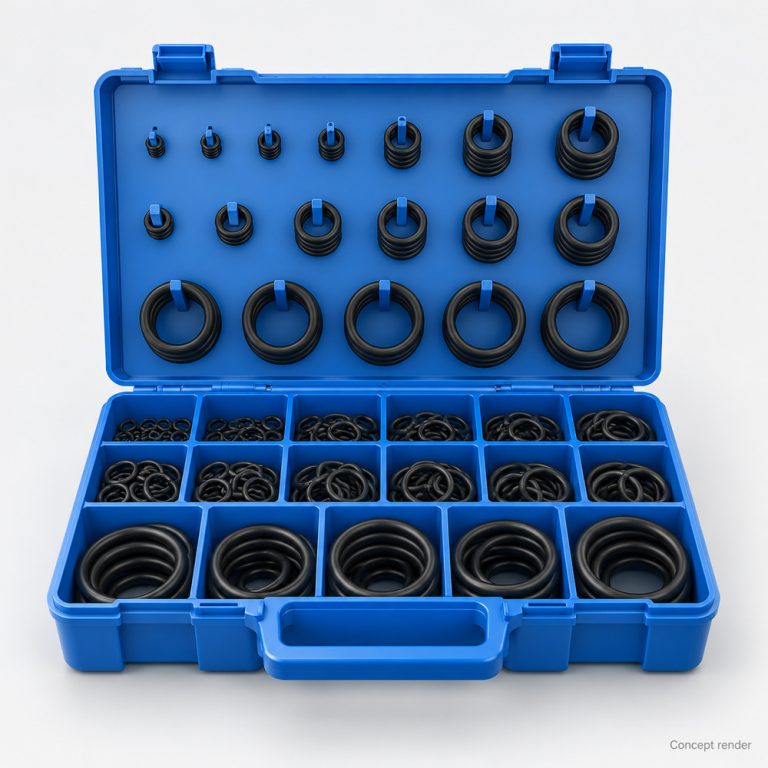 O-ring KitsAn O-ring kit is a boxed assortment of common sizes in one compound, designed so that a maintenance…View
 Hydraulic SealsHydraulic seals contain pressurised oil in cylinders, rams, presses and valves while keeping dirt out and controlling friction.…View
 Sealants and Industrial AdhesivesSealants and adhesives complement mechanical seals and gaskets by locking fasteners, sealing threads, bonding parts and filling flange…View
 Pneumatic SealsPneumatic seals work in compressed-air systems, where the medium is a gas, pressures are lower than in hydraulics…View
 Rotary Shaft and Oil SealsRotary shaft seals, commonly called oil seals, keep lubricant in and contaminants out where a rotating shaft passes…View
 Wiper and Scraper SealsA wiper, also called a scraper or dust seal, sits at the outer end of a cylinder gland…View
Send the thread size, washer dimensions and fluid and we will help you find the right bonded seal.
Send your brief, quantities and deadline. We reply with a clear written quote and confirm the turnaround before anything goes to production.
