
Cartridge seals
Cartridge Seals for Pumps, Mixers and Process Equipment
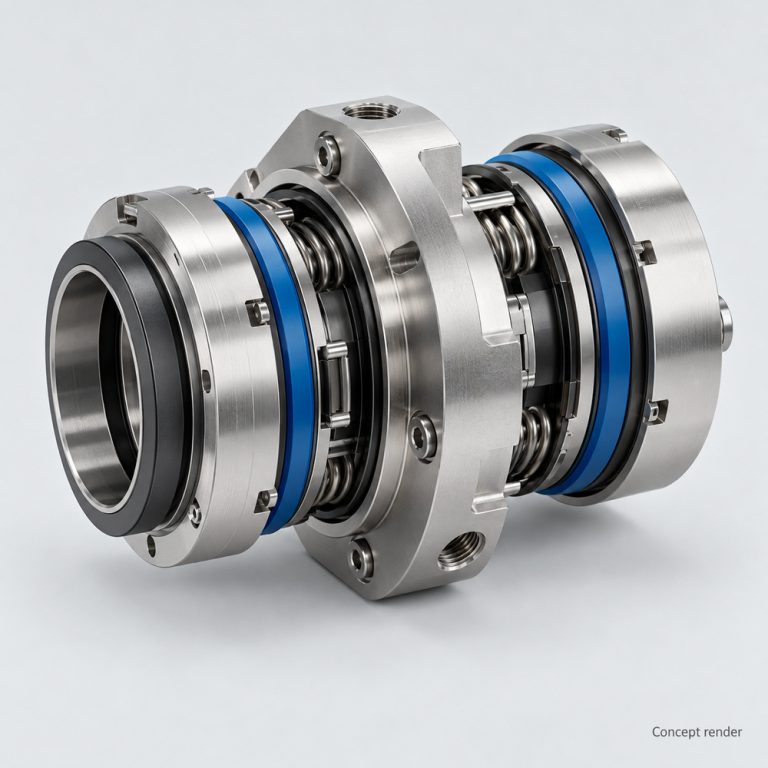
A cartridge seal is a complete mechanical seal assembled by the manufacturer on a sleeve and gland plate, with the faces already set to the correct working length. Instead of measuring and setting individual parts on site, the fitter slides the cartridge over the shaft, bolts the gland up, tightens the drive collar and removes the setting clips. Globseals can help you find the correct cartridge seal, or quote for an equivalent, using your equipment details.
- Pre-assembled and pre-set
- Single and double cartridge designs
- Fewer fitting errors on site
- Equipment-based identification

Overview
Fitting errors are a common cause of early mechanical seal failure: wrong installed length, dirt on faces, damaged elastomers or uneven gland tightening. A cartridge seal removes most of those steps by delivering the faces already compressed and aligned. The setting clips (or tabs) hold the position until the seal is bolted up, then are moved clear so the faces can float.
Cartridge designs are common on standardised process pumps, on equipment built to API 682 and on many mixers and agitators. They also help where maintenance teams change seals frequently or where fitters vary in experience. The trade-off is a higher unit price than loose components and a design that must fit the pump's chamber and gland envelope. Where only the wearing parts need to be replaced and the metalwork is reusable, Component Mechanical Seals may be an alternative. The wider category overview is on our Mechanical Seals page.
Cartridge seal configurations
Single cartridge seals
One set of faces with the sleeve, gland and drive collar integrated. Suited to many clean or lightly contaminated services, often with a simple flush from the pump discharge.
Double cartridge seals
Two seal sets in one unit, used with a barrier or buffer liquid. These are typically considered where leakage to atmosphere must be controlled or the liquid is hazardous, abrasive or prone to solidifying. They require a supply system, covered under Seal Support and Supply Systems.
Back-to-back and tandem layouts
Back-to-back double seals pressurise the barrier above process pressure. Tandem layouts use an unpressurised buffer between seals. The arrangement you need depends on the duty and any plant or site standard.
Gas-lubricated cartridge seals
Dry gas versions use a gas barrier and grooved faces to run without liquid contact, and are used mainly on compressors and certain mixers. They need correct gas supply and technical review.
Mixer and agitator cartridges
Designed for vertical shafts, often with larger shaft diameters, lower speeds and top-entry or bottom-entry mounting, sometimes with dry-running capability.
Split cartridge seals
Split designs can be installed around a shaft without dismantling the driver, useful for large or hard-to-access equipment. Fit accuracy depends on careful assembly and the split mechanism.
Materials in cartridge seals
Cartridge seals combine the same face and elastomer choices as other mechanical seals, with additional metal parts for the sleeve and gland. These are typical options, not rules. Always confirm against the manufacturer's data for your application.
- Faces: carbon against silicon carbide is a common pairing for general duty, silicon carbide against silicon carbide where abrasives are present, and tungsten carbide for tougher mechanical duty.
- Sleeves and glands: 316-type stainless steel is typical. Duplex or nickel alloys are chosen when chloride or acid corrosion is a concern.
- Secondary seals: EPDM for water-based service, FKM for many oils and hydrocarbons, perfluoroelastomer or PTFE-based for aggressive chemicals. See the elastomer comparison.
- Springs and drive parts: alloy choice matters when the liquid is corrosive, since springs can be exposed to the process.
Choosing the right cartridge seal
The key difference from loose-component selection is that a cartridge has fixed dimensions, so the chamber must be measured carefully before ordering.
- Shaft diameter at the sleeve seat, and whether the pump has a shaft sleeve already.
- Seal chamber bore, depth and gland bolt pattern. A cartridge that does not fit the chamber cannot be adapted easily.
- Axial space: the distance from the chamber face to the nearest shaft obstruction.
- Flush and port positions: where the flush, quench, drain and vent ports sit on the gland.
- Arrangement: single or double, and any supply system already installed.
- Drive method: set screws, clamp collar or keyed drive.
Where the pump cannot be identified, ask for a technical review before ordering.
Information to send us
- Pump make, model and serial number, or the equipment drawing
- Existing cartridge seal part number or label
- Shaft or sleeve diameter, chamber bore, depth and gland bolt circle
- Port positions and sizes for flush, quench, drain and vent
- Fluid, temperature, pressure and speed
- Photos of the current seal installed and removed
- Quantity, and whether you also need a support system
Genuine and compatible replacements
Genuine cartridge seals come from the brand fitted to the equipment. Compatible cartridges are built to match the same shaft, chamber and gland dimensions, and some are designed as direct replacements for named OEM models. Check dimensional equivalence, face materials, elastomers and flush connections before relying on compatibility, because small port or bolt-pattern differences can prevent fitting.
You can enquire about genuine or compatible replacement parts for equipment from manufacturers such as Burgmann, John Crane, Chesterton, Flowserve, KSB and Sulzer. Supply route and lead times are confirmed when you enquire.
How to buy
Because cartridge seals are dimension-specific, most orders benefit from a check before purchase.
- Buy online: where a product is listed in the online shop with a confirmed price, you can order directly. Products are being added to the shop progressively, so not every item will be listed yet.
- Request a quote: for custom, bulk, unpriced or repeat-order requirements, send us a quote request with your details.
- Technical review: if you cannot identify the part, or the application is demanding, use Find My Seal or upload a drawing and our team will review it with you.
You can also call head office in Johannesburg on 011 079 6033, or WhatsApp 079 508 0989, or email info@globseals.com.
Options & specifications
| Configurations | Single, double back-to-back, tandem, split and gas-lubricated |
|---|---|
| Common applications | Process pumps, API-style pumps, mixers, agitators |
| Typical face pairs | Carbon with silicon carbide; silicon carbide with silicon carbide; tungsten carbide options |
| Typical sleeve and gland metals | 316-type stainless steel; duplex or nickel alloys for aggressive media |
| Fitting aid | Setting clips or tabs to fix working length until bolted up |
| Key sizing data | Shaft diameter, chamber bore and depth, gland bolt pattern, port positions |
Options, materials and turnaround are confirmed on your written quote.
How ordering works
- 1
Confirm the pump
Send the make, model and nameplate details.
- 2
Measure the chamber
Record shaft size, chamber bore, depth and gland pattern.
- 3
Define the duty
State liquid, temperature, pressure, speed and arrangement.
- 4
Order or request review
Buy a listed item, request a quote, or ask for technical review.
Frequently asked questions
What is the advantage of a cartridge seal?
It arrives with faces pre-set, which removes most of the measuring and setting errors that cause early failure. It is usually quicker to fit, but it costs more than loose components.
Can I fit a cartridge seal in place of a component seal?
Sometimes, but only if the seal chamber and gland envelope accommodate the cartridge. Measure the chamber and ask for a technical review before ordering.
Do I need to remove the setting clips?
Yes. After the gland is bolted up and the drive collar tightened, the clips are moved clear so the faces can follow the shaft. Failing to do so is a known cause of rapid seal damage. Always follow the manufacturer's fitting sheet.
Do double cartridge seals need a barrier system?
Yes. They normally need a barrier or buffer liquid supply, with pressure and temperature monitoring suited to the arrangement. See seal support and supply systems.
Can you supply cartridge seals for imported pumps?
You can enquire about genuine or compatible cartridge seals for many pump brands. Send the pump details and we will confirm what can be supplied.
Request a quote for Cartridge Seals
Related services
 Mechanical SealsA mechanical seal controls leakage where a rotating shaft passes through a stationary housing, most often on centrifugal…View
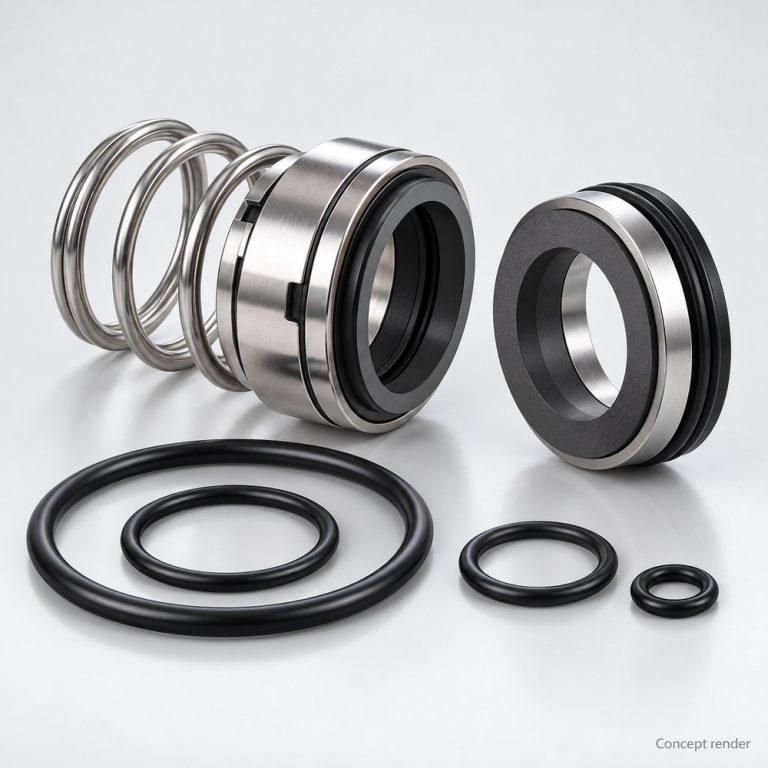
 Component Mechanical SealsComponent mechanical seals are supplied as separate parts, not as a factory-assembled cartridge. The fitter sets the working…View
 Seal Support and Supply SystemsA mechanical seal does not work alone. It depends on the environment around it: cool, clean liquid at…View
 Mechanical Seal RepairsA leaking mechanical seal does not always need a full replacement. Depending on the design and the damage,…View
 Pumps and Pump SparesGlobseals supplies pump spares and, on enquiry, pumps for water, process and general industrial duty. Pump spares are…View
 Carbon Floating Ring SealsCarbon floating ring seals are non-contacting or lightly contacting restriction seals used on turbines, compressors, blowers and some…View
 Hydraulic SealsHydraulic seals contain pressurised oil in cylinders, rams, presses and valves while keeping dirt out and controlling friction.…View
 Pneumatic SealsPneumatic seals work in compressed-air systems, where the medium is a gas, pressures are lower than in hydraulics…View
Send the pump model and chamber dimensions and we will help you find the right cartridge seal.
Send your brief, quantities and deadline. We reply with a clear written quote and confirm the turnaround before anything goes to production.
