
Pipework flexibility
Expansion Joints
Expansion joints absorb thermal movement, misalignment and vibration in pipework so that pumps, valves and vessels are not overstressed. They are common on pump suction and discharge lines, cooling water circuits and HVAC. Globseals can help you identify the joint type, movements and flange details and quote the right unit.
- Rubber and PTFE-lined joints
- Metal bellows on enquiry
- Movement and flange details
- Quote or technical review
Overview
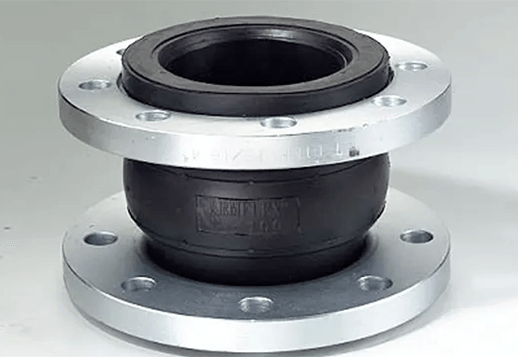
An expansion joint is a flexible section of pipe, usually flanged at both ends. It lets the pipework compress, extend or deflect without transferring large forces to connected equipment. Selection depends on how much movement the line will see, the pressure and vacuum, the temperature and the medium.
Expansion joints do not replace correct pipe support or anchoring. Pressure thrust can push a joint apart unless control rods or anchors resist it, so rod design must be reviewed for the application.
Types
- Single-arch and multi-arch rubber joints: reinforced with fabric, used for water, air, and many chemicals depending on liner.
- PTFE-lined joints: for aggressive chemicals, with a PTFE bellows or liner.
- Metal bellows: stainless or alloy for high temperature or pressure, normally designed to an application.
- Fabric expansion joints: for ducting and gas flows at low pressure.
- Control units and tie rods: limit extension and protect against pressure thrust.
- Rubber flexible connectors: smaller threaded or flanged connectors for vibration isolation.
Materials and construction
| Part | Common materials | Notes |
|---|---|---|
| Cover and tube | EPDM, NBR, neoprene, butyl, FKM | Match the polymer to the medium; see the elastomer comparison. |
| Reinforcement | Nylon or polyester cord, steel wire rings | Sets pressure and vacuum capability. |
| Flanges | Carbon steel, galvanised, stainless | Should match the mating flange standard. |
| Liner | PTFE | For corrosive duty. |
Ratings differ between products, so values here are typical only; always confirm against the manufacturer's data for your application.
How to choose
- Measure the installed face-to-face length and the flange standard, size and drilling.
- List movement: axial compression and extension, lateral offset and angular deflection.
- State maximum pressure and vacuum, including surge and test pressure.
- Give the medium and temperature.
- Decide whether tie rods or control units are needed, and how the pipework is anchored.
Potable-water duty requires technical review and the correct certification documents. Metal bellows are designed to movement and cycle-life calculations, so they require technical review.
Information to send with your enquiry
The more of the following you can supply, the faster the part can be identified and quoted.
- Nominal size and flange standard (SANS, EN, ASME, BS)
- Installed face-to-face length
- Movements: axial, lateral, angular
- Pressure, vacuum and test pressure
- Medium and temperature
- Single or multi-arch, rubber, PTFE or metal
- Tie rods or control units required
- Pump or equipment it is fitted to
Genuine and compatible replacements
Customers can enquire about genuine or compatible replacement parts for equipment from manufacturers such as Burgmann, John Crane, Chesterton, Grundfos, KSB, Flygt, Lowara, Goulds, Sulzer, Flowserve, Klinger, Flexitallic, Trelleborg and others. A genuine part is supplied by or made to the original equipment manufacturer's specification and part number. A compatible part is made to fit the same dimensions and duty, usually by another manufacturer, and may differ in material or finish. A compatible expansion joint matches size, length and flange drilling, but the cord reinforcement and cover rubber may differ, which affects pressure rating and life. Ask for the specification. State clearly in your enquiry which you want, and say whether a part number or sample is available.
How to buy
Globseals supports three ways to buy, and the right one depends on how well the part is defined.
- Buy online where a product listing shows a confirmed price. Products are being added to the shop progressively, so not every item in this category is listed yet.
- Request a quote for custom, bulk or unpriced items. Standard sizes and repeat orders are quoted. Use the quote request page.
- Technical review when identification is unresolved. Examples include metal bellows, hazardous media, high-temperature duty, and unknown movement. Start with Find My Seal or upload a drawing.
You can also phone 011 079 6033 or WhatsApp 079 508 0989, or email info@globseals.com. See delivery and collection for how orders are handled; courier costs are quoted per order.
Options & specifications
| Types available | Single-arch, multi-arch, PTFE-lined, fabric, metal bellows |
|---|---|
| Common polymers | EPDM, NBR, neoprene, butyl, FKM |
| Movements | Axial, lateral, angular; specify on enquiry |
| End connections | Flanged to SANS, EN, ASME or BS |
| Typical use | Pump connections, cooling water, HVAC, process lines |
| Order mode | Quote; technical review for metal or hazardous duty |
Options, materials and turnaround are confirmed on your written quote.
How ordering works
- 1
Identify
Gather part number, dimensions or a photo of the part.
- 2
Send
Submit it through the quote form, WhatsApp or email.
- 3
Review
Our team checks the details and asks about any gaps.
- 4
Order
Confirm the quote or buy online where a price is listed.
Frequently asked questions
Where should an expansion joint be installed?
Normally next to the equipment it protects, such as the suction and discharge of a pump, with proper anchors so thrust is carried by the structure and not by the joint.
Do I need tie rods?
Tie rods or control units limit extension and carry pressure thrust. Whether they are needed depends on pressure, anchoring and the joint design.
What is the difference between compression and extension movement?
Compression shortens the joint along the pipe axis and extension lengthens it. Rubber joints usually allow more compression than extension.
Can I use a rubber expansion joint for steam?
Only specific designs and temperatures. This requires technical review.
What measurements do I need to send?
Flange details, installed length, pressure and movement are the essentials; a photo of the existing joint helps.
Request a quote for Expansion Joints
Related services
 Pumps and Pump SparesGlobseals supplies pump spares and, on enquiry, pumps for water, process and general industrial duty. Pump spares are…View
 Valves and Valve SparesValves control, isolate or protect pipework, and their sealing parts, namely stem packing, seats, body gaskets and O-rings,…View
 Hoses and FittingsHoses and fittings connect pumps, tanks and process equipment, and incorrect threads or hose ratings are the most…View
 Rubber Gaskets and Elastomer ProductsRubber gaskets and elastomer parts cover a broad range: flat gaskets cut from sheet, strip and cord, moulded…View
- Pump and Seal Maintenance GuideGood maintenance extends seal life and reduces unplanned stops. This guide offers a general routine for pumps and…View
 Request a QuoteUse this page for custom, bulk or unpriced items, or whenever you want a written quotation. A good…View
 Filtration and Water Treatment ProductsFiltration protects pumps, seals and process equipment from solids, and water treatment components condition the fluid for the…View
- Couplings and Magnetic CouplingsCouplings connect a driver, usually an electric motor, to a pump, gearbox or other driven machine, and they…View
Send size, length and movements for an expansion joint quote.
Send your brief, quantities and deadline. We reply with a clear written quote and confirm the turnaround before anything goes to production.
