
O-ring cords
O-ring Cord and Cord Stock
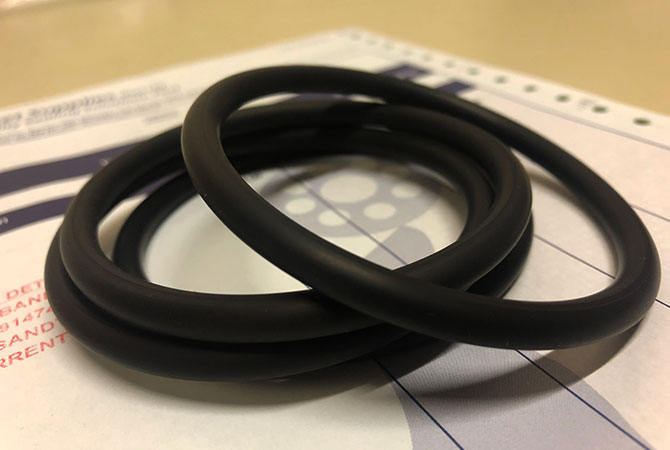
O-ring cord is round-section elastomer supplied in lengths or coils, used to make O-rings that are not available as standard moulded sizes. It is common for large door and cover seals, repairs on machinery that cannot be fully dismantled, and one-off or low-volume rings. Globseals can help you choose the cord material and diameter, and advise whether a joined ring is suitable for your duty.
- Round cord in a range of diameters
- NBR, EPDM, FKM, silicone and more
- Custom-length joined rings
- Joint suitability advice
Overview
Cord is sold by the metre or in coils, and the user (or supplier) cuts it to length and joins the ends to form a ring. The cross-section of the cord matches the cross-section of the finished O-ring, so you choose the diameter from the groove, in the same way as for a moulded ring.
The joint is the limitation. A properly made vulcanised or spliced joint can be reliable in static and low-pressure service, while a glued joint (typically cyanoacrylate) is a quick repair that is generally less durable. Joined rings are normally not recommended for high-pressure, dynamic or critical service. Where possible, a moulded ring from Metric O-rings or Imperial O-rings is preferable. For a loose workshop assortment, see O-ring Kits.
Cord types and joining methods
Solid round cord
The standard product, in diameters from about 1 mm up to well over 10 mm. Available in a range of compounds and hardnesses.
Hollow or sponge cord
Compressible cord used in door seals and low-pressure gasketing. It is not a replacement for solid O-ring cord in pressure sealing.
PTFE cord
Expanded PTFE cord is soft and conforms to uneven flanges, and is used for chemical resistance. It is not elastic like rubber.
Glued joint
Ends cut square or at an angle and bonded with adhesive. Quick, but strength and sealing depend on the cut, surface preparation and adhesive.
Vulcanised joint
Ends heat-bonded in a mould or press, giving a stronger joint with elastomer-matching properties. Usually made by the supplier.
Spliced rings from the supplier
Rings made to order from cord, at a size that may not exist as a moulded ring.
Cord materials
Material selection follows the same logic as for moulded rings. These notes are typical and general. Always confirm against the manufacturer's data for your application.
- NBR: mineral oils, fuels and water at moderate temperature. The most common general-purpose cord.
- EPDM: hot water, steam in suitable grades and many dilute chemicals. Not for mineral oils.
- FKM: oils, fuels and chemicals at higher temperatures. Cord is stiffer than NBR and joints can be harder to make well.
- Silicone (VMQ): wide temperature range and flexible, widely used for door seals. Low tear strength.
- Neoprene (CR): moderate resistance to oils and weather, used in general industrial sealing.
- PTFE: broad chemical resistance, no elasticity, and suited to static flange sealing.
- Hardness: 70 Shore A is a common default. Softer cords seal more easily at low load, and harder cords resist extrusion.
How to choose and cut cord
- Decide whether cord is the right solution. If a standard moulded size exists, it is usually the better ring.
- Pick the diameter from the groove, not from a worn ring. See the O-ring measuring guide.
- Calculate the cut length. The ring should lie slightly stretched or just fit in the groove. As a rule of thumb, the cut length is based on the mean circumference of the groove (at the cross-section centre), reduced slightly for a small stretch. Excess stretch thins the cross-section, so keep it low.
- Choose the joint method from the duty: glued for temporary or static low-pressure, vulcanised for more demanding use.
- Select the compound for the fluid and temperature.
- Rule out critical duty. High pressure, dynamic use, oxygen, food-contact, pharma or potable-water service need technical review and the correct certification documents.
Information to send us
- Cord diameter and the groove width and depth, or the finished ring size you need
- Required finished length or inside diameter
- Material and hardness, or the fluid, temperature and pressure
- Static or dynamic use
- Joint method wanted, or the duty so we can advise
- Quantity of metres or finished rings
- Photos of the groove or equipment
Genuine and compatible replacements
Cord is a commodity-style product, so genuine OEM cord is rarely relevant. What matters is the compound, tolerance on diameter and the quality of the cord extrusion. Different suppliers vary in diameter tolerance, which affects compression. For finished joined rings, workmanship also varies. Request material details when the ring is for a more demanding duty.
You can enquire about replacement rings for equipment from manufacturers such as Trelleborg, Freudenberg/Simrit and Aston Seals, whether genuine, compatible or made from cord.
How to buy
Cord and joined rings are usually quoted because length, material and joint method vary.
- Buy online: where a product is listed in the online shop with a confirmed price, you can order directly. Products are being added to the shop progressively, so not every item will be listed yet.
- Request a quote: for custom, bulk, unpriced or repeat-order requirements, send us a quote request with your details.
- Technical review: if you cannot identify the part, or the application is demanding, use Find My Seal or upload a drawing and our team will review it with you.
You can also call head office in Johannesburg on 011 079 6033, or WhatsApp 079 508 0989, or email info@globseals.com.
Options & specifications
| Cord section | Solid round, in a range of diameters; hollow and PTFE types also exist |
|---|---|
| Common materials | NBR, EPDM, FKM, silicone, neoprene, PTFE |
| Typical hardness | 60 to 90 Shore A, with 70 Shore A common |
| Joint methods | Glued (cyanoacrylate) and vulcanised |
| Typical use | Large seals, repairs, one-off and low-volume rings |
| Supplied as | By the metre, coil or as finished joined rings |
Options, materials and turnaround are confirmed on your written quote.
How ordering works
- 1
Check for a moulded ring
Confirm whether a standard size will do.
- 2
Measure the groove
Record width, depth and mean diameter.
- 3
Choose material and joint
Select by fluid, temperature and duty.
- 4
Quote or order
Request a quote for lengths or joined rings.
Frequently asked questions
Is a cord ring as good as a moulded O-ring?
For static, low-pressure service, a well-made joint can perform well. For high-pressure, dynamic or critical duty, a moulded ring is normally preferred.
Can I glue cord myself?
Many workshops do it as a repair. Cut the ends square, keep them clean and use an adhesive suitable for the cord material. Some compounds, such as silicone and EPDM, need special primers. Treat a glued ring as a temporary solution for important duty.
How long should I cut the cord?
Base it on the mean groove circumference, adjusting slightly for stretch. Cutting too short thins the ring and cutting too long makes it buckle. Test fit before final joining.
Do you supply spliced rings?
Send the size, material and quantity and we will quote. Capability and method are confirmed when you enquire.
Which cord diameters are available?
Diameters vary with material. Send your required diameter and compound and we will confirm what can be supplied.
Request a quote for O-ring Cords
Related services
 Metric O-ringsMetric O-rings are described by inside diameter and cross-section in millimetres, for example 20 x 3. They are…View
 Imperial O-ringsImperial O-rings are sized in inches, most commonly to the AS568 standard used on American-built equipment, and to…View
 O-ring KitsAn O-ring kit is a boxed assortment of common sizes in one compound, designed so that a maintenance…View
 Rubber Gaskets and Elastomer ProductsRubber gaskets and elastomer parts cover a broad range: flat gaskets cut from sheet, strip and cord, moulded…View
 Special Products and Engineered ComponentsNot every part appears in a catalogue. Older machines, imported equipment and modified plant often need seals, bushes,…View
 Mechanical SealsA mechanical seal controls leakage where a rotating shaft passes through a stationary housing, most often on centrifugal…View
 Cartridge SealsA cartridge seal is a complete mechanical seal assembled by the manufacturer on a sleeve and gland plate,…View
 Component Mechanical SealsComponent mechanical seals are supplied as separate parts, not as a factory-assembled cartridge. The fitter sets the working…View
Send the groove size, material and quantity and we will quote for cord or a joined ring.
Send your brief, quantities and deadline. We reply with a clear written quote and confirm the turnaround before anything goes to production.
