
Backup rings
Backup Rings and Anti-Extrusion Rings
A backup ring is a hard, thin ring fitted beside an O-ring or lip seal on the low-pressure side of the groove. It fills the clearance gap and stops the softer seal from being squeezed (extruded) into it. Backup rings are used in hydraulic cylinders, valves, high-pressure pumps and fittings. Globseals can help you select the right type, material and dimensions for the groove.
- Spiral, scarf-cut and solid types
- PTFE and nylon materials
- Sized to groove and O-ring
- Fitting-side guidance
Overview
Under pressure, an elastomer behaves a little like a very viscous fluid. If the gap between the moving or mating parts is too wide for the pressure and hardness, the O-ring is pushed into it, nibbles and fails. A backup ring has two jobs: to close the gap, and to stay put. Because it is stiff, it does not seal on its own and must be used with a sealing element.
Backup rings are matched to the groove and the O-ring size, so they are normally ordered by the same dimensions: inside diameter, outside diameter and thickness. They are often needed with high-pressure O-rings from Metric O-rings and Imperial O-rings, and with lip seals in Hydraulic Seals. In many cases, a 90 Shore A O-ring or a tighter clearance can reduce the need for one.
Types of backup ring
Solid (endless) rings
A continuous ring with no joint, usually made from PTFE or filled PTFE. They give the strongest support but must be stretched or squeezed over the piston or into the bore, so groove design must allow installation.
Scarf-cut (single-turn) rings
A ring cut at an angle so the ends overlap. Easy to fit in closed grooves. The cut needs to be positioned correctly and may allow slight leakage of the O-ring material in extreme cases.
Spiral (helical) rings
A coiled band, typically PTFE, that is wound into the groove. Installed easily, and can be cut to length on site. They are often used in repair work.
Concave and flat profiles
Concave rings follow the O-ring shape and give better support, while flat rings are simpler. The groove design determines the choice.
Single and double (bidirectional) arrangements
Fit one backup ring on the low-pressure side for pressure in one direction. Use two if pressure reverses and the gap is exposed on both sides.
Anti-extrusion rings in lip seals
Some U-cup and chevron seals have a separate or integral anti-extrusion element. Check the manufacturer's design before adding another ring.
Backup ring materials
These notes are typical and general. Always confirm limits against the manufacturer's data and the fluid compatibility.
- Virgin PTFE: the usual material for backup rings. Chemically resistant with low friction, but creeps under sustained load.
- Filled PTFE (glass, carbon, bronze): improved creep and wear resistance. The filler must suit the fluid, and bronze may be attacked by some media.
- Nylon (polyamide): stiffer and cheaper in some forms, but absorbs moisture and has lower chemical resistance than PTFE.
- PEEK and other engineering plastics: used where temperature and pressure are high and the cost is acceptable. Technical review is advised.
- Hard rubber or fabric-reinforced elastomer: used in some shaped backup arrangements.
How to select backup rings
- Establish whether you need one. Consider pressure, extrusion gap and O-ring hardness together, using the manufacturer's extrusion limits, not guesswork. Higher pressures and larger gaps increase the risk.
- Identify the pressure direction. Fit a ring on the side away from the pressure, which is the low-pressure side. Use two for alternating pressure.
- Check the groove width. A groove that was designed for an O-ring alone must be widened to accommodate backup rings. Otherwise the ring will overfill.
- Choose the type that can be installed in your groove: solid, scarf-cut or spiral.
- Match the dimensions to the O-ring and groove diameter.
- Select the material by fluid and temperature.
Information to send us
- O-ring size (inside diameter x cross-section) and compound
- Groove dimensions: diameter, width and depth
- Radial clearance or extrusion gap
- Operating pressure, including peaks, and direction of pressure
- Fluid and temperature
- Static or dynamic use, and whether it is a piston or rod groove
- Quantity and preferred backup ring type
Genuine and compatible replacements
Backup rings are made by seal manufacturers and by general sealing suppliers to standard dimensions that follow common O-ring groove designs. Genuine rings supplied by an equipment manufacturer may be to special dimensions. Compatible rings in PTFE or nylon work well if the dimensions match, but material grade, thickness tolerance and cut quality vary, so confirm them for high-pressure duty.
You can enquire about genuine or compatible rings for equipment from manufacturers such as Hallite, Trelleborg, Freudenberg/Simrit and Aston Seals.
How to buy
Backup rings depend on the groove, so exact dimensions help.
- Buy online: where a product is listed in the online shop with a confirmed price, you can order directly. Products are being added to the shop progressively, so not every item will be listed yet.
- Request a quote: for custom, bulk, unpriced or repeat-order requirements, send us a quote request with your details.
- Technical review: if you cannot identify the part, or the application is demanding, use Find My Seal or upload a drawing and our team will review it with you.
You can also call head office in Johannesburg on 011 079 6033, or WhatsApp 079 508 0989, or email info@globseals.com.
Options & specifications
| Types | Solid, scarf-cut (single-turn), spiral, concave and flat |
|---|---|
| Common materials | Virgin PTFE, filled PTFE, nylon, PEEK |
| Position | Low-pressure side of the O-ring; two for bidirectional pressure |
| Used with | O-rings and some lip seals |
| Size reference | Inside diameter, outside diameter and thickness |
| Key design data | Pressure, extrusion gap, groove width, O-ring hardness |
Options, materials and turnaround are confirmed on your written quote.
How ordering works
- 1
Check the need
Compare pressure, gap and hardness with the O-ring data.
- 2
Measure the groove
Record diameter, width and clearance.
- 3
Choose type and material
Select by installation method and fluid.
- 4
Order or review
Buy listed items or request a quote or review.
Frequently asked questions
Do all O-rings need backup rings?
No. Many static and low-pressure applications work without them. Backup rings are mainly for higher pressure or larger gaps, and for dynamic seals where extrusion is a risk.
Which side does the backup ring go on?
On the low-pressure side, so that it supports the O-ring against the gap. If the pressure reverses, fit one on each side.
Can I add a backup ring to an existing groove?
Only if the groove is wide enough. Otherwise the O-ring and ring will be overfilled, causing damage or poor sealing. Check the groove dimensions first.
Is a spiral ring as good as a solid one?
Solid rings give the best support, but spiral rings are easier to fit, particularly in a closed groove. Choose by the application, with a solid ring preferred when installation allows.
What is the difference between a backup ring and a wear ring?
A backup ring supports a seal against extrusion. A wear ring carries side loads. They are separate parts. See wear rings and guide rings.
Request a quote for Backup Rings
Related services
 Metric O-ringsMetric O-rings are described by inside diameter and cross-section in millimetres, for example 20 x 3. They are…View
 Imperial O-ringsImperial O-rings are sized in inches, most commonly to the AS568 standard used on American-built equipment, and to…View
 Hydraulic SealsHydraulic seals contain pressurised oil in cylinders, rams, presses and valves while keeping dirt out and controlling friction.…View
 Piston SealsA piston seal seals the gap between the piston and the cylinder bore so that pressure on one…View
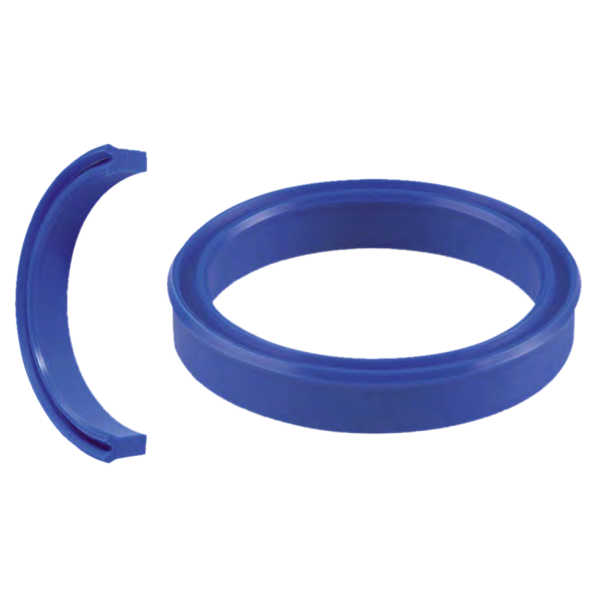 Rod SealsThe rod seal is the main barrier between pressurised oil inside a hydraulic cylinder and the outside world.…View
 Pneumatic SealsPneumatic seals work in compressed-air systems, where the medium is a gas, pressures are lower than in hydraulics…View
 Rotary Shaft and Oil SealsRotary shaft seals, commonly called oil seals, keep lubricant in and contaminants out where a rotating shaft passes…View
 Bonded SealsA bonded seal is a metal washer with an elastomer sealing ring vulcanised to its inside edge. It…View
Send the O-ring size, groove details and pressure and we will help you choose a backup ring.
Send your brief, quantities and deadline. We reply with a clear written quote and confirm the turnaround before anything goes to production.
