
Measuring guide
How to Measure an O-ring
An O-ring is defined by two dimensions and a material. Get the inside diameter and cross-section right, note the medium and temperature, and identification becomes straightforward. This guide shows how to measure a used or new O-ring and what to send when you ask us to confirm the size.
- Inside diameter
- Cross-section
- Material check
- Send photos
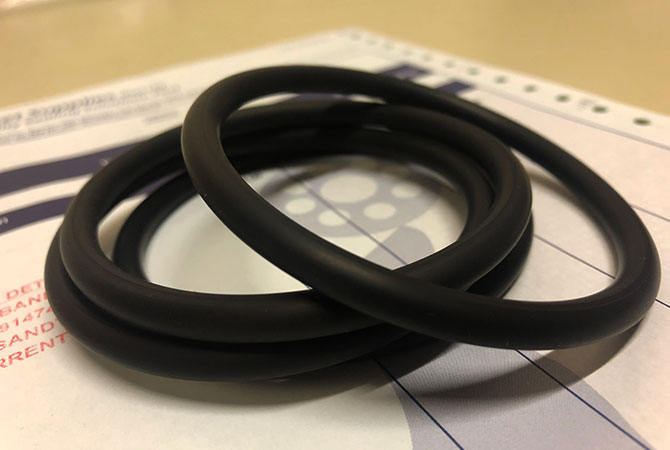
What you need to measure
A pair of digital or vernier callipers is the best tool. A steel rule is acceptable for rough sizing of large rings, but it is not precise enough to separate neighbouring standard sizes. An O-ring size cone or gauge helps if you have one. Work on a clean ring at room temperature and handle it gently, because rubber stretches and compresses easily.
Step-by-step measurement
- Clean the ring. Remove oil, dirt and any glue or sealant so the true shape shows.
- Measure the cross-section (CS). Close the callipers lightly across the thickness of the ring, at several points around the circumference. Do not squeeze. Used rings are often flattened, so measure the least-worn area and note the average.
- Measure the inside diameter (ID). Lay the ring flat without stretching it and measure across the inside opening. For small rings, place the callipers’ inside jaws in the ring and open until they just touch. For large rings, measure across at least two positions at right angles and average them.
- Calculate the outside diameter (OD) as a check. OD = ID + (2 x CS). If you can measure the OD directly, the numbers should agree.
- Record the figures in millimetres or inches. Note which unit you used. Metric and imperial rings can look similar but are not interchangeable.
Measuring a used or worn ring
Rings that have been in service for a long time may have taken a compression set, swollen in the medium or hardened. The measured size can therefore differ from the original. If the ring is badly deformed, measure the groove instead (see below) and send the groove dimensions and the equipment details along with the ring photograph. A ring that has swollen suggests a material compatibility problem, which is worth flagging so the material can be reviewed.
Measuring the groove or housing
When the old ring is missing or damaged, the groove tells you what the seal must fit. Measure the groove diameter, the groove width and the groove depth. For a static face seal, also note whether the ring sits in a face groove or on a bore. For a piston or rod application, measure the bore and the rod or piston diameter. The groove dimensions are used to select a cross-section and ID that give suitable compression and fill, which is part of the sizing decision rather than a direct measurement of the ring.
Identifying the material
Dimensions alone do not complete the specification. The elastomer determines whether the ring survives its medium and temperature. Colour is not a reliable identifier, since manufacturers use different colours for the same material. Instead, tell us what the ring seals (hydraulic oil, water, fuel, steam, chemicals, food products) and the operating temperature range. See the NBR, EPDM, FKM and silicone comparison for typical material behaviour.
Metric, imperial and standard sizes
O-rings are supplied in metric and imperial (inch-based) series, and some sizes sit very close together. A ring that measures roughly 25 mm may be a metric size or an inch size, so state the unit you measured in and give decimals. Browse the metric O-rings and imperial O-rings ranges, or the O-ring cords if you need to cut a ring to length.
Limitations of this guide
- Measuring a worn ring gives an estimate of the original size, not a certainty.
- Stretching a ring while measuring the ID gives a falsely large reading.
- The measurements do not tell you whether the groove design is correct for the pressure, speed or movement involved.
- Material guidance here is general. Always confirm against the manufacturer's data for your application.
- For oxygen, hydrogen, aerospace, food-contact, pharmaceutical or potable water duty, the application requires technical review and the correct certification documents.
What to send us
Send the ID, CS and unit, the number of rings required, the equipment or part number it comes from, the medium, the operating temperature and whether the ring is static or moving. A clear photograph of the ring next to a ruler helps. If a full set is needed for a service, consider an O-ring kit. Use the Find My Seal page or request a quote.
Options & specifications
| Key dimensions | Inside diameter and cross-section |
|---|---|
| Unit systems | Metric and imperial |
| Tool | Digital or vernier callipers |
Options, materials and turnaround are confirmed on your written quote.
How ordering works
- 1
Clean
Remove dirt and oil.
- 2
Measure CS
Across the thickness, several points.
- 3
Measure ID
Flat, unstretched.
- 4
Check OD
ID plus twice the CS.
Frequently asked questions
How do I measure an O-ring if I only have a ruler?
Lay the ring flat and measure across the inside opening, then the thickness of the ring. A ruler is only good for rough sizing. Send your measurements and a photograph and we can help confirm the nearest standard size.
Is the inside diameter the same as the outside diameter minus the thickness?
Not quite. OD = ID + 2 x cross-section, so ID = OD minus twice the cross-section.
Can I tell the material from the colour?
No. Colours vary between manufacturers and compounds. Tell us the medium and temperature so the material can be reviewed.
What if the O-ring is too worn to measure?
Measure the groove and housing, and send details of the equipment. We can then suggest a size for review.
Explore
 Metric O-ringsMetric O-rings are described by inside diameter and cross-section in millimetres, for example 20 x 3. They are…View
 Imperial O-ringsImperial O-rings are sized in inches, most commonly to the AS568 standard used on American-built equipment, and to…View
- O-ring CordsO-ring cord is round-section elastomer supplied in lengths or coils, used to make O-rings that are not available…View
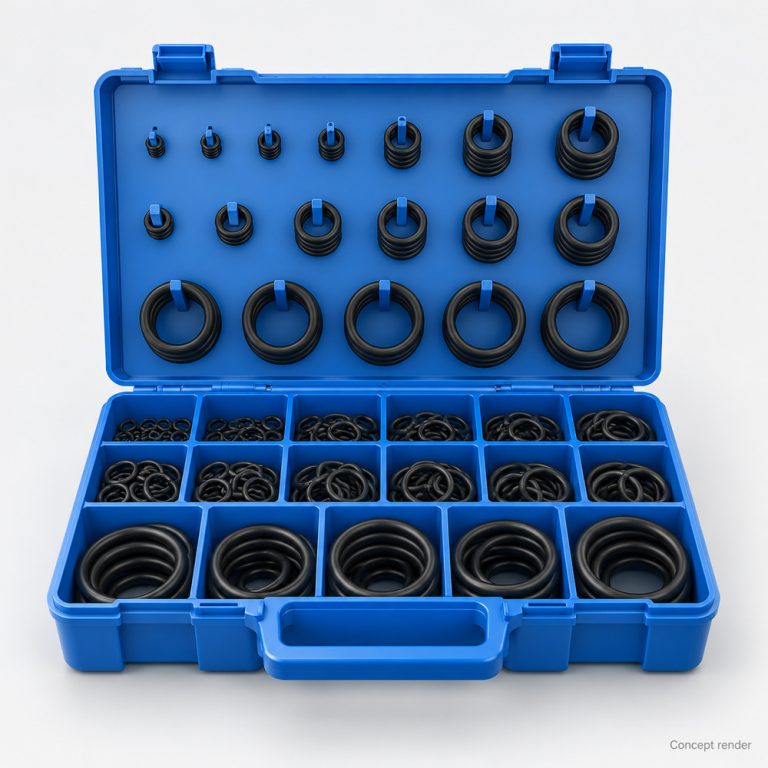 O-ring KitsAn O-ring kit is a boxed assortment of common sizes in one compound, designed so that a maintenance…View
- NBR, EPDM, FKM and Silicone ComparisonFour elastomers account for a large share of O-rings and rubber seals: nitrile (NBR), EPDM, fluoroelastomer (FKM) and…View
 Find My SealIf you do not have a part number, dimensions are the next best route. Tell us the type…View
 How to Measure a Hydraulic SealHydraulic seals are normally specified by groove dimensions, because the seal must fit a particular housing. This guide…View
 Gasket Material Selection GuideNo single gasket material suits every flange. Choosing well means matching the material to the medium, temperature, pressure,…View
Send your O-ring measurements for confirmation.
Send your brief, quantities and deadline. We reply with a clear written quote and confirm the turnaround before anything goes to production.
