
Measuring guide
How to Measure a Hydraulic Seal
Hydraulic seals are normally specified by groove dimensions, because the seal must fit a particular housing. This guide explains how to measure a cylinder, identify the seal position, and gather the information needed for a quotation.
- Bore and rod
- Groove size
- Seal position
- Profile photos

Identify the seal position
Before measuring, decide which seal you are replacing:
- Rod seal seals against the piston rod and holds oil inside the cylinder. See rod seals.
- Piston seal seals the piston to the cylinder bore. See piston seals.
- Wiper or scraper sits at the outer end of the gland and keeps dirt out. See wiper and scraper seals.
- Wear ring or guide ring carries side loads. See wear rings.
- Backup rings support O-rings and similar seals against extrusion. See backup rings.
Tools and preparation
Use digital callipers, an inside micrometer or bore gauge where possible, and a depth gauge for grooves. Clean the cylinder components thoroughly. Take photographs of the seal in place before removing it, noting which way it faces, since many profiles are directional.
Rod seal and wiper measurements
- Measure the rod diameter (d) where the seal runs.
- Measure the groove diameter (D) in the gland.
- Measure the groove width (L) between the groove walls.
- Note the housing type: closed groove or open (split) gland.
The seal size is usually written as d x D x L. For wipers, measure the same dimensions and note whether the wiper is pressed in, snap-in or retained by a flange.
Piston seal measurements
- Measure the bore diameter (D).
- Measure the piston groove diameter (d).
- Measure the groove width (L).
- Record whether the piston is single-acting or double-acting, and whether any wear rings share the piston.
Recognising the profile
Lay the old seal on a flat surface and look at its cross-section. Cut a small slice if you can do so on a spare or scrap seal. Take a photograph of the profile and the lip direction. Note the visible parts, such as an energising O-ring, a PTFE slipper ring, a fabric-reinforced section or a metal insert. Bonded washers and similar parts fall under bonded seals. For rotating shafts, see rotary shaft and oil seals.
Record the working conditions
The best-fitting seal can still fail if the material or design is wrong. Note the fluid (mineral oil, water-glycol, fire-resistant fluids and so on), working pressure, temperature, stroke length, speed and any side loading. Typical materials include nitrile, polyurethane, FKM and PTFE-based compounds, but suitability depends on the application. Always confirm against the manufacturer's data for your application.
Limitations
- A worn seal and a worn groove can both mislead; measure the housing, not just the old seal.
- The same dimensions may be served by several profiles, so profile and direction matter.
- Dimensions do not confirm pressure or speed capability.
- For cylinder repair work, see hydraulic cylinder sealing support; applications that need special certification require technical review.
What to send
Send d, D and L (or bore details), the seal position, a photograph of the old seal and profile, the equipment make and model, fluid, temperature, pressure and quantity. Use request a quote, upload a drawing, or the main hydraulic seals range.
Options & specifications
| Rod seal | d x D x L |
|---|---|
| Piston seal | D x d x L |
| Also record | Fluid, pressure, temperature, stroke |
Options, materials and turnaround are confirmed on your written quote.
How ordering works
- 1
Position
Rod, piston, wiper or wear ring.
- 2
Measure
d, D and L.
- 3
Profile
Photograph cross-section.
- 4
Duty
Fluid, pressure, temperature.
Frequently asked questions
Do I measure the seal or the groove?
Measure the groove and the rod or bore, and also the old seal if available. Groove dimensions are the more reliable reference.
Can one seal profile replace another?
Sometimes, but only after review of the groove, fluid, pressure and movement.
How do I know which way the seal faces?
Photograph it before removal. Lips and energisers normally face the pressure side.
Explore
- Hydraulic SealsHydraulic seals contain pressurised oil in cylinders, rams, presses and valves while keeping dirt out and controlling friction.…View
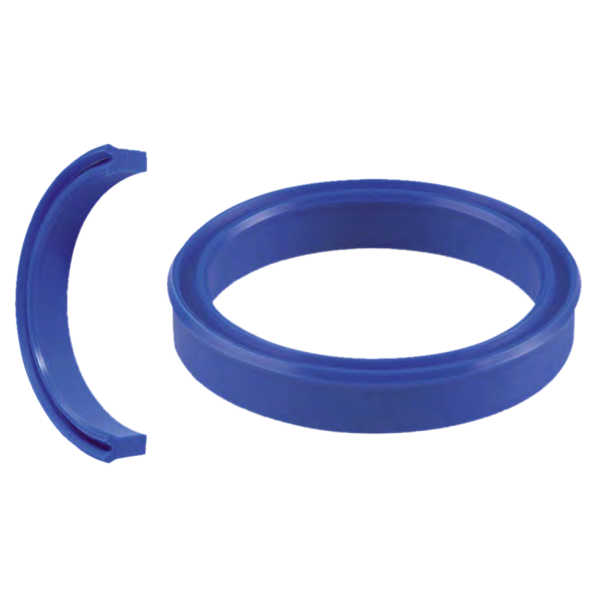 Rod SealsThe rod seal is the main barrier between pressurised oil inside a hydraulic cylinder and the outside world.…View
 Piston SealsA piston seal seals the gap between the piston and the cylinder bore so that pressure on one…View
 Wiper and Scraper SealsA wiper, also called a scraper or dust seal, sits at the outer end of a cylinder gland…View
 Wear Rings and Guide RingsWear rings, also called guide rings, bearing rings or wear bands, are non-sealing rings that keep a piston…View
- Hydraulic Cylinder Sealing SupportA leaking or drifting hydraulic cylinder usually needs the right seal kit, not guesswork. Globseals supports customers with…View
 How to Measure an O-ringAn O-ring is defined by two dimensions and a material. Get the inside diameter and cross-section right, note…View
 Gasket Material Selection GuideNo single gasket material suits every flange. Choosing well means matching the material to the medium, temperature, pressure,…View
Send your cylinder dimensions for a quote.
Send your brief, quantities and deadline. We reply with a clear written quote and confirm the turnaround before anything goes to production.
